Tack Button
A tack button is a mainly metal button that secures fabric by sandwiching it between the front button body and a nail-like tack driven in from the back, and is fixed with a dedicated setting tool.
Contents6 sections
Definition and Overview
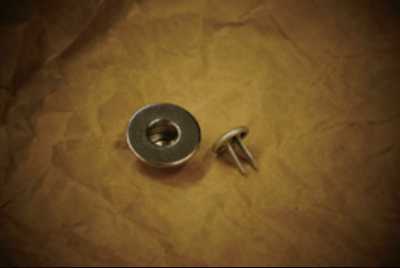
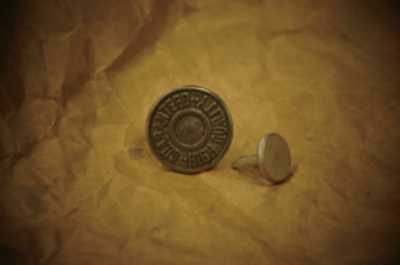
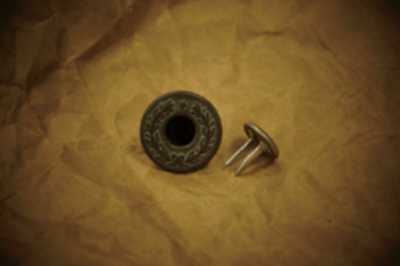
A tack button is a button attached by combining the button body with a nail-shaped fastener called a tack. Unlike ordinary buttons sewn on with sewing thread, it is used for thick fabrics because the tack is pushed through the textile and crimped to the body.
It is also sometimes called a jeans button or donut button. The name varies depending on distribution and design, but all generally refer to a drive-in type with a round metal button body visible on the front side.
Materials and Structure
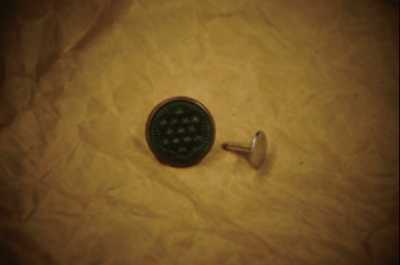
Most are made of metal, using brass, iron, zinc alloy, or similar materials, and are finished with plating or paint on the surface. The front of the body may be flat, donut-shaped with a recessed center, or engraved with stamps or patterns.
Ordinary tack buttons do not have holes for thread on the surface. On the back side, there is a tubular or crimping structure that receives the tack, and the tack shaft is driven in and fixed. They also differ from structures that use sewing legs like shank buttons.
- Button body: the head visible on the front side.
- Tack: a nail-shaped part that passes through the textile and joins to the body.
- Washer/reinforcement material: depending on the textile and specification, resistance to pullout is improved with a pressing cloth or similar material.
Size Notation and Applications
Sizes are shown by the outer diameter of the button body in mm, and may also be expressed in lignes. One ligne is approx. 0.635 mm, so values cannot be compared by number alone when the unit differs. When ordering, in addition to the unit, confirm the measured outer diameter and the corresponding tack standard.
They are mainly used for the front opening and waist area of jeans, denim pants, chino pants, and similar garments. They are also used on workwear, blousons, skirts, and bags, but the structure is selected according to the fabric thickness at the application, tensile load, and ease of opening and closing.
Attachment and Handling Precautions
For attachment, use a hand press or hand press suitable for the combination of the body and tack. Avoid fabric edges and overlapping seam allowances, and decide the position including whether reinforcement is needed. Before mass production, it is important to do a trial press with the same fabric construction and check holding force and surface damage.
During washing or product washing, contact with other metal parts or the washing tub may cause scratches, plating wear, or discoloration. Suitability for dry cleaning also varies depending on the finish and attached components, so perform pretesting in line with the care label. When ironing, do not apply the hot soleplate directly for a long time, and take care not to damage the surrounding textile.
Insufficient setting can lead to looseness or detachment, while excessive crimping can deform the body or tear the textile. In particular, for thick textiles, stretch textiles, or textiles with low weave density, confirm whether the tack length and reinforcement specification are suitable.
Differences from Similar Terms
A neoba button is a drive-in type button that may sometimes be used with a meaning close to tack button. However, since the scope of the name and the component structure may differ by trading partner or manufacturer, confirm not only the term but also the body shape, tack type, and compatible hand press.
Dot buttons, spring hooks, and jumper hooks are types of snaps that open and close by attaching and detaching male and female parts. By contrast, a tack button is normally used by passing it through a buttonhole, and the body and tack are fixed parts that do not open and close after attachment.
Frequently Asked Questions
Can a tack button be sewn on?
Ordinary tack buttons do not have holes for sewing and are attached by driving in the tack, so they are normally not sewn on. If attaching by hand, choose a button with a structure that can be fixed with thread, such as a two-hole button, four-hole button, or shank button.
What should be checked to prevent a tack button from coming off?
Check the compatibility of the body and tack, tack length, fabric thickness, attachment position, and whether reinforcement is necessary. Do a trial press with the same fabric, interlining, and seam allowance construction, and inspect after repeated opening and closing and after tension to see whether there is looseness, pullout, or fabric tearing.