


Batiste
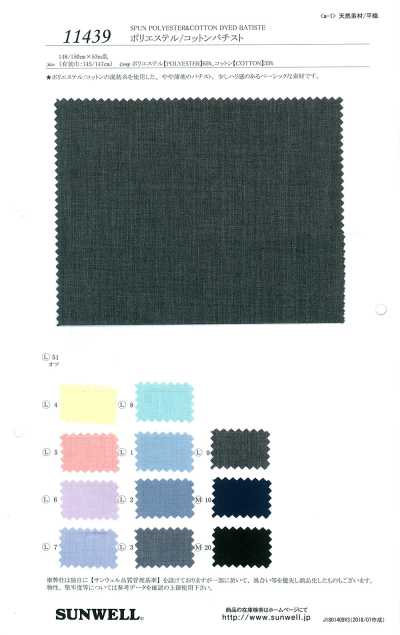
Batiste is a plain weave fabric that is often woven densely using fine-count yarns, with a thin, lightweight, and smooth texture.
Contents6 sections
Definition and Overview
Batiste is a thin, delicate plain weave fabric that is generally woven with fine yarns such as cotton. Its surface is relatively smooth, and it has a light, soft hand. It is used as a name that refers not to the material itself, but to the thinness of the textile and its weave characteristics.
Cotton is the typical material, but depending on the application and development plan, blends with polyester and other fibers are also used. Even with the same name, the feel of the fabric can vary in sheerness, firmness, and touch depending on the raw material, yarn thickness, density, and finishing.
Characteristics
Its thin, light look and gentle touch are its defining features. Thanks to its dense plain weave, the surface is relatively even despite being a thin fabric, making it a textile that easily creates an elegant and clean impression.
It is easy to achieve breathability, making it suitable for spring and summer apparel. On the other hand, light-colored or lightweight product numbers can be prone to sheerness, so care is needed with friction and strong force. Absorbency, quick-drying performance, and wrinkle behavior depend on the blended fibers and finishing processes.
Main Applications
It is used for blouses, shirts, dresses, skirts, baby and kids' clothing, and nightwear. Making use of its lightness, it is also suitable for designs with gathers and tucks, and for items where a soft feel against the skin is desired.
It may be used to take advantage of its sheerness as a design feature, or combined with lining or a double-layer construction. Outside apparel, it may be used for applications that require delicacy, such as handkerchiefs and embroidery bases.
How to Choose and Handling Notes
When selecting it, check not only the composition but also the fabric weight, density, sheerness, whiteness, and drape on an actual sample. The suitable product number changes depending on whether moderate firmness is needed for shirting or softness is prioritized for blouse fabric. For light colors, also consider specifications for preventing sheerness.
Batiste made mainly from cotton may shrink when washed. Before mass production, carry out wash tests and check shrinkage, and if necessary consider relaxing the fabric or pre-washing it. In accordance with the care label, it is basic practice to wash dark colors separately to prevent color transfer.
Because it is a thin fabric, the grainline may shift during cutting, and seam shrinkage or puckering may occur during sewing. Choose a fine needle and sewing thread of a fine count suited to the fabric, and adjust upper and lower thread tension, feed amount, and stitch length through test stitching.
Differences from Similar Terms
Lawn is a thin plain weave made with fine yarns and is used for applications similar to batiste. There is some commercial overlap in how the two names are used and classified, so it is important not to judge quality by name alone and to check the composition, density, thickness, and sheerness.
Voile often uses highly twisted yarns and is characterized by a crisp cool feel and a slightly sheer appearance. Batiste is often smoother on the surface than voile, with a softer and gentler hand. Broadcloth generally has more thickness and a denser feel than batiste.
FAQ
Is batiste the same fabric as lawn?
Both are used for similar applications as thin plain weave fabrics, but they are not completely synonymous. The way the names are used varies by region and supplier. When choosing a fabric, compare the composition, fabric weight, density, sheerness, and hand feel with a swatch rather than relying on the name.
Is batiste sheer?
Because it is thin, it can be sheer, especially in light colors. However, sheerness varies greatly depending on yarn thickness, weave density, composition, color, and finishing. In products, it may be used together with lining, facings, or a double-layer construction, or with the assumption that it will be worn with inner layers.
What should be noted when sewing batiste?
With thin, slippery fabric, take care to avoid grainline shifts, seam shrinkage, and puckering. Before cutting, straighten the grain and use a fine needle and a fine-count sewing thread suited to the fabric. It is important to test-stitch and adjust the sewing conditions for each fabric.





