Gathering
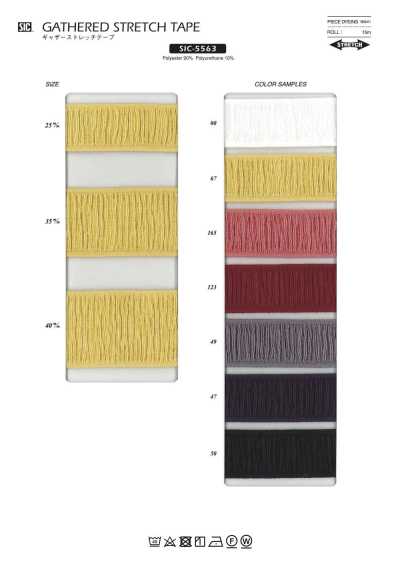
Gathering is a sewing technique that gathers excess fullness by sewing and shortening one edge of a fabric, evenly or intentionally, to create raised volume, ease, and decorative effect.
Contents6 sections
Definition and Overview
Gathering is a method of sewing where a long fabric edge is reduced to the length of a shorter seam line and joined together. The gathered area creates fine folds and fullness, giving garments ease, drape, and a decorative appearance. It is used at the neckline and cuffs of skirts, dresses, and blouses.
In general, a gathering stitch is sewn with a coarse stitch length, and the thread is pulled to gather the fabric. After adjusting the amount of gathering, the fineness of the folds, and their distribution, the piece is stitched to the matching part, and the gathering thread is removed if necessary.
Role in Product Development
At the planning stage, the gathering position and finished fullness are shown in the design sketch and specification sheet, and the pattern is set to the expanded dimensions before gathering. Because the required fabric allowance and the final appearance vary depending on fabric width, print, and the drape of the material, this is considered in parallel with material selection.
In the sewing process, the work often proceeds in the order of cutting, gathering, distributing the fullness, stitching to the matching part, finishing the seam allowance, and pressing. For lined products or products with facings, steps to reduce seam allowance bulk and prevent show-through on the right side are also important.
Procedure and Practical Points
Instructions should clearly specify the section to be gathered, the dimensions before and after gathering, the finished dimensions, and how the fullness is distributed from the center or notches. Whether the gathering is even throughout or concentrated toward the center or side should also be shared in the specification sheet or physical sample.
With thin or slippery fabrics, the thread tends to shift unevenly when pulled, while with thick fabrics, seam allowance bulk tends to build up. Methods such as using multiple rows of stitching for stability and adjusting the tension of the gathering stitch are selected according to the fabric and sewing equipment.
- Provide notches at the gathering stop points to prevent shrinking beyond the required area.
- Distribute the fullness evenly before stitching and secure it with pins or basting.
- For patterned fabrics, check how the pattern appearance changes with gathering.
- For high-fullness specifications, decide in advance the seam allowance direction and pressing method.
Ordering and Quality Considerations
When placing an order with a sewing factory, communicate not only the finished gathered dimensions but also the dimensions before gathering, the gathering position, evenness, and the appearance on the right side. In samples, also check the spread when worn, left-right differences, and dimensional changes after washing, and keep a standard sample for mass production.
For quality inspection, check for insufficient or excessive gathering, uneven distribution of fullness, stitching-in, puckering, and broken stitches. In stretch fabrics and delicate thin fabrics, stitch distortion, thread tension, and needle marks also affect the appearance, so trial sewing before mass production is necessary.
Differences from Similar Terms
Tucks are a specification in which the fabric is folded and the fullness is controlled by the fold line or stitching. Gathering creates soft fullness through a series of continuous fine folds, whereas tucks have relatively clear fold lines and more readily create a neat, structured dimensional effect.
Ease is a technique that slightly shrinks one piece of fabric, such as a sleeve cap, so it follows a three-dimensional shape. Unlike gathering, it is not intended to show folds and differs in that it creates a natural curve without visible folds on the surface.
Frequently Asked Questions
How do you choose between gathering and tucks?
Gathering is suitable when you want soft, continuous fullness or volume that moves with the garment. Tucks are suitable when you want a neat appearance or a fixed amount of fullness by making use of fold lines. Choose while also considering fabric thickness, pattern, and seam allowance bulk.
What information must always be communicated to the factory for a gathered specification?
Communicate the section to be gathered, the dimensions before and after gathering, the distribution of fullness, the stop point, and the direction in which the seam allowance is turned. Whether the gathering is even or concentrated in certain areas can be interpreted differently if described only in words, so it is important to show it with a specification drawing, notches, and a physical sample.
What causes gathering to be uneven?
Possible causes include inappropriate stitch length or thread tension on the gathering stitch, uneven force when pulling the thread, and a lack of sectioning by notches. Fabric slip and stretch also have an effect, so distribute the fullness by section before stitching and sew after securing it.