Warp
Warp is the yarn that runs in the lengthwise direction of a woven fabric (the direction parallel to the selvedge). Before weaving, the required number of yarns is prepared and stretched parallel to the loom, and the fabric is woven by passing the weft yarns through and crossing them.
Contents7 sections
Definition and Overview
Warp is the yarn that runs in the lengthwise direction of a woven fabric. It is also written as "warp thread," "horizontal yarn," or "vertical yarn." Before weaving, the required number and length of yarns are prepared to match the fabric width and density, wound onto beams (warping), and stretched parallel to the loom. The stretched warp yarns are opened up and the weft yarns are passed through one by one to interlace them, creating the fabric.
The direction parallel to the fabric selvage, in other words the lengthwise direction of the bolt, is the warp direction. The grain line used as the cutting reference is usually also set in this direction.
What Warp Needs
Warp is under tension throughout weaving and also rubs against the loom's heddles and reed. For that reason, yarns that are less likely to break and have less fuzz are often chosen, and spun yarns such as cotton are sized before weaving to reinforce them, then desized after weaving. Using compact yarn with less fuzz for the warp produces chino and broadcloth with a cleaner surface.
Once warp is set, weaving continues with the same yarn until it is used up. For that reason, it is common to keep the same warp while changing only the weft color or material to weave fabrics with different colors and textures.
Effect on Fabric Appearance and Function
The warp's material, thickness, twist, and color affect the fabric's appearance and properties. In structures such as satin, where more warp is brought to the surface, the sheen and color of the warp determine the surface impression. Using filament yarn for the warp makes it easier to create a smooth surface and drape.
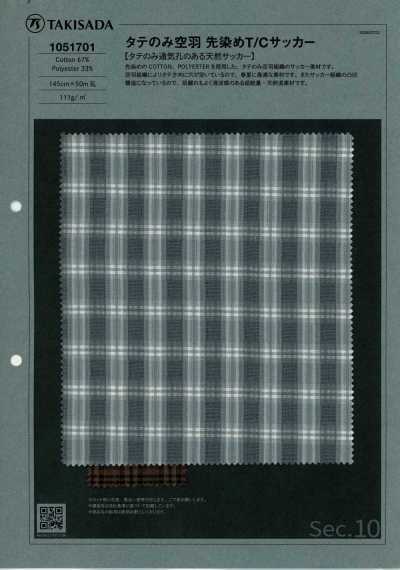
If differently colored yarns are arranged in the warp, the result is stripes; if they are also arranged in the weft, the result is checks. Changing the colors of the warp and weft creates chambray, which changes color depending on the viewing angle. Some fabrics, such as seersucker, are woven with differences in warp tension to create striped raised-and-lowered texture.
The warp direction is the direction that stretches less and tends to keep its shape better. However, there are also warp-stretch fabrics made with elastic yarn such as polyurethane in the warp so that they stretch in the lengthwise direction.
How It Is Expressed in Fabric Specifications
In fabric specifications, it is common to list yarn count and density in the order of warp, then weft. For example, "40×40/133×72" for cotton broadcloth means that both the warp and weft use 40-count yarn, with 133 warp yarns and 72 weft yarns per inch (2.54 cm). Warp density is called warp density.
The number of warp yarns is determined by the fabric width and warp density. In wide-width, high-density fabrics, several thousand to nearly 10,000 warp yarns are arranged.
Points to Note in Cutting and Sewing
The basic rule is to place the pattern so that the grain line matches the warp direction. After confirming the warp direction with the selvage attached, the fabric is cut. If the grain line is off, side seams may twist after wear or washing, and stripes may appear slanted.
The amount of shrinkage from washing or steam often differs between the lengthwise and crosswise directions. Before deciding fabric consumption, check the shrinkage rate separately for the lengthwise and crosswise directions. If the warp breaks or the tension becomes irregular, it may appear as streaks in the lengthwise direction (warp streaks), so this is checked during fabric inspection.
Differences from Similar Terms
Weft is the yarn passed in the widthwise direction between the stretched warp yarns. Warp and weft are distinguished by their roles in weaving: warp is the yarn set on the loom first, and weft is the yarn inserted afterward. A combined explanation of both is found under "warp and weft."
In warp knitting, too, the yarns are called warp because many warped yarns are fed in the lengthwise direction to knit. However, in warp knitting the yarns are connected by loops and are not interlaced like warp and weft in woven fabric.
Frequently Asked Questions
How do you read "warp"?
It is read as "tateito." It is also written as "warp thread," "horizontal yarn," or "vertical yarn," and all mean the same thing.
Which direction of the fabric is the warp?
The direction parallel to the selvage, in other words the lengthwise direction of the bolt, is the warp. In fabric cut from without selvages, the less-stretchy direction is often the warp, but this may not apply for stretch fabrics, so check the pattern direction or the specification sheet.
What do the numbers in "40×40/133×72" mean?
They indicate yarn count and density. "40×40" means both the warp and weft are 40-count yarn, and "133×72" means there are 133 warp yarns and 72 weft yarns per inch. Both are written in the order of warp, then weft.