Weft Insertion
Weft insertion is a structure in which yarns are inserted in the weft direction into knitted fabric such as warp knits to help prevent stretching and loss of shape while maintaining flexibility.
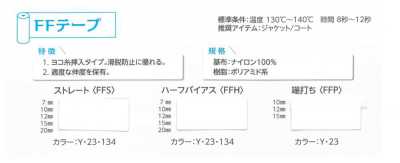
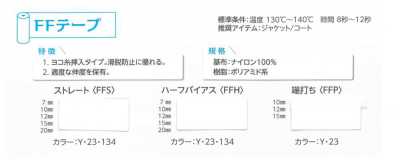
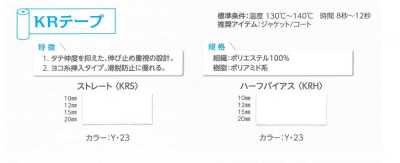
![FFH-OUTLET Half Bias Tape Outlet [outlet]](/img/item/thumb/OKURA/FFH_t2.jpg)
Contents5 sections
Definition and Overview
Weft insertion is a structure in which weft yarns are laid across and held in the width direction, mainly in warp-knit base fabrics. Compared with knits made only of loops, it is easier to give dimensional stability in the width direction, and in some cases it can produce a look and firmness closer to woven fabric.
In anti-stretch tape, it is used to follow garment movement to a certain extent while preventing seams and edges from stretching more than necessary. Weft insertion is not a term that indicates the cutting direction of the tape, but a term that indicates the tape itself's structure.
Areas of Use and Role
It is used in areas where shape distortion due to stretching should be suppressed, such as shoulder seams, armholes, pocket openings, front edges, necklines, and zipper attachment positions. The basic idea is not to completely stop the stretch of the outer fabric, but to add the stability needed for each area.
Especially in lightweight fabrics, knits, and cut pieces that include the bias direction, it helps suppress stretching and waviness during sewing. On the other hand, if it is made too stable, it may cause pressure marks or wear distortion when worn, so the need for each area should be checked.
Types and Differences in Cutting and Bonding
Weft insertion tape includes a non-bonded type that is sewn in place and a bonded type with adhesive resin applied to one side. The non-bonded type is fixed by sewing, while the bonded type can be temporarily fixed or fixed by pressing before sewing, so it is selected according to the process and specifications.
Straight tape, bias tape, and half-bias tape are classifications that mainly indicate the cutting direction relative to the grain and how much they stretch. Weft insertion is a classification of structure, so both the cutting direction and weft insertion may be shown in the description of the same product.
- The straight direction is used for straight sections where stretch should be suppressed.
- The bias direction is easier to conform to curved sections, but the degree of stretch must be checked.
- Half-bias is used with the intention of providing followability between straight and bias.
- For the bonded type, compatibility with the outer fabric and pressing conditions must be checked.
How to Choose and Precautions for Bonding and Sewing
Select a width that fits within the seam allowance and can stabilize the required area. If it is too narrow, holding power may be insufficient, and if it is too wide, stiffness or step differences may become noticeable. Match the amount of stretch and recovery when the tape is extended to the outer fabric and the area of use.
For the bonded type, test it with the outer fabric and tape before full production, and check the bonding temperature, time, and pressure. With heat-sensitive materials or materials with surface texture or pile, attention is needed for uneven bonding, pressure marks, and bleed-through.
During sewing, it is important not to pull the tape or the outer fabric while sewing. To prevent puckering or waviness caused by differences in feed amount, check the presser foot pressure, feed, and stitch conditions, and also confirm the tape's ability to follow curves in advance.
Frequently Asked Questions
Are weft insertion tape and anti-stretch tape the same?
Anti-stretch tape is a name that indicates the application, while weft insertion is a name that mainly indicates the structure of the tape or base fabric. Weft insertion structures are used for anti-stretch tape, but not all anti-stretch tape is weft insertion.
Can weft insertion tape be used on the bias?
It depends on the product design. Even within weft insertion, cutting directions such as straight, bias, and half-bias, as well as stretch characteristics, differ. When used on curved sections, confirm ease of bending and the required anti-stretch effect with a sample stitch test.
Does the bonded type also need sewing?
It depends on the specifications of the area. Bonding is useful for positioning and shape stability, but it is generally used together with sewing in joined sections. Considering washing and wear loads, judge whether bonding alone is sufficient for each specification.