Double-sided Fusible Tape
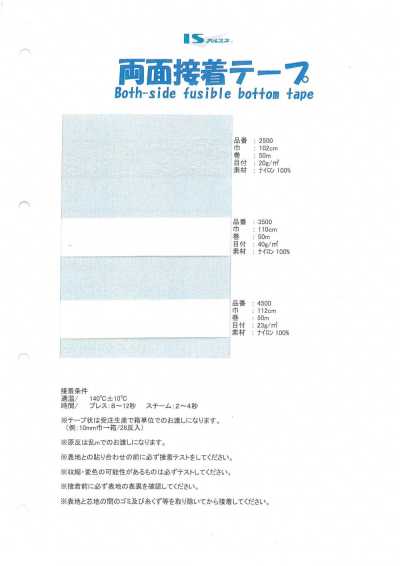
Double-sided fusible tape is a dressmaking supply that has heat-activated adhesive resin on both sides of the tape and is used to bond textile, interfacing, and similar materials for stretch control and temporary fixation.
Contents5 sections
Definition and Overview
Double-sided fusible tape is a narrow tape whose both sides adhere by heat and pressure. It is used by sandwiching it between fabric and fabric, or fabric and interfacing, for positioning before sewing, reinforcing edges, and temporary bonding.
Unlike adhesive tape with adhesive on only one side, it bonds to the materials on both sides. Because its adhesion method and wash resistance differ from ordinary office double-sided tape, choose one whose fusing conditions are specified for apparel use.
Areas of Use and Roles
It is used for temporary fixation and shape stabilization at areas that tend to shift during sewing, such as the front edge, facing, collar and pocket edges, and hem. Because it can hold small parts in place before sewing, it is also useful when you want to reduce damage to the textile caused by pins or basting.
When used on cut edges that are prone to stretching, its resistance to stretching also helps suppress dimensional change. However, fixing areas that require strong stretchability may interfere with stretch during wear.
- Preventing shifting at facings and front edges
- Partial fixation around necklines and armholes
- Temporary fixation at pocket openings, hems, and folded edges
- Areas where interfacing or reinforcing fabric is partially bonded
Types and Differences by Cutting Method
Stretch-prevention tapes are divided into straight, half bias, and bias types according to how they are cut relative to the grain. Straight cuts are good at suppressing stretch, while bias cuts conform more easily to curves but allow stretch in some directions.
Adhesive specifications include one-sided adhesive, double-sided adhesive, and sew-on types with no adhesive. Double-sided fusible tape is intended for applications where both the front and back sides are bonded. Conformability to curves, thickness, and the base material such as woven, knitted, or nonwoven fabric vary by product.
Selection and Precautions for Fusing and Sewing
Choose the width according to the area to be fixed and the seam allowance width. If it is too wide, stiffness or the outline of the bonded area may show through the surface; if too narrow, sufficient holding power may be hard to obtain. Also check compatibility with the outer fabric's thickness, structure, and stretchability.
For fusing, it is important to follow the conditions for temperature, time, pressure, and cooling. Before mass production, test on the same textile to check for insufficient bonding, peeling, bleed-through onto the outer fabric, fading, or changes in hand.
During sewing, if the tape edge continues to overlap the needle entry position, it may increase the load on the needle and thread and create stiffness around the needle holes. Consider the placement within the seam allowance, the needle entry position, and the flexibility required after sewing in advance.
Frequently Asked Questions
Are double-sided fusible tape and stretch-prevention tape the same?
No, they do not mean the same thing. Stretch-prevention tape is categorized by its purpose of suppressing stretching at fabric edges, and there are also one-sided adhesive and sew-on types. Double-sided fusible tape is a name indicating an adhesive specification that bonds both sides, and it may also be used for stretch-prevention applications.
Is it okay to bond it with an iron only?
You can do prototypes with a household iron, but insufficient set temperature, pressing time, or pressure can cause peeling. Check whether a pressing cloth is needed at a temperature that will not damage the outer fabric, and confirm the appearance and washing durability after bonding using the same fabric and process as the final production.