Basting Clip
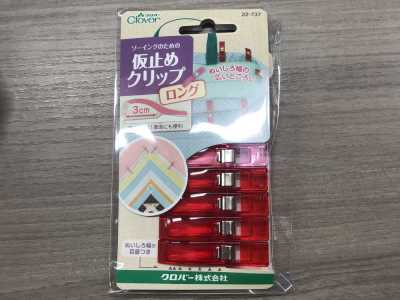
A basting clip is a clip-shaped tool used to temporarily hold fabric or materials in place before sewing by clamping them together, and it is also easy to use on materials where pinholes are likely to remain from straight pins.

Contents6 sections
Definition and Overview
A basting clip is a tool for holding the edges of fabric or seam allowances to be sewn together and aligning them before machine sewing or hand sewing. Because it holds with spring tension, it can temporarily secure materials without using pins.
It is especially used for laminated textiles, synthetic leather, leather, and other materials where pinholes show easily or where straight pins are hard to insert. It is also suitable for securing thick layered sections.
How to Use
Align the seam allowance, pattern, or edge position, and clamp the seam allowance outside the stitching line with the clip. Fasten them at the necessary intervals starting from the fabric edge, and remove clips near the presser foot just before sewing.
If you leave the clip attached and run it into the needle or presser foot, it may cause needle breakage or machine damage. On curved sections or thick fabrics, reduce the spacing so the fabric does not shift, and sew while checking little by little.
- Attach it to the seam allowance side, not on the stitching line.
- Before sewing, check the right and wrong sides and the direction the seam allowance will be pressed.
- On thick sections, make sure the clip is gripping firmly enough.
Types and How to Choose
Common basting clips include standard shapes that are easy to use with fabrics from light to medium weight, as well as types with a wide opening that can clamp multiple layers of fabric or thick materials more easily. Transparent or semi-transparent types may make it easier to check the fabric edge and the position of the lower layer.
When choosing one, check the thickness of the section to be clamped, the required holding force, how wide the opening is, and whether the size is easy to handle by hand. For delicate light fabrics, it is reassuring to test on a scrap first to see whether the clip leaves marks or causes surface changes from pressure.
Care and Safety Precautions
After use, remove lint and any adhesive residue, and store away from humidity and direct sunlight. Do not use clips with weak spring action, chipped tips, or noticeably reduced clamping force, as they may damage the fabric or come loose during work.
Because it is a small part, it may snap shut forcefully if opened strongly. Handle carefully so your fingers or skin do not get caught, and store it out of the reach of infants and small children. In addition, leather and surface-finished materials require a preliminary test to avoid marks from long-term clamping.
Differences from Similar Terms
A straight pin is a tool that secures fabric by piercing it with the tip, and it is good for fine positioning and temporarily securing curved sections. A basting clip, on the other hand, is less likely to leave pinholes and is easier to use on thick sections, but it may be harder to use on narrow seam allowances or in tight areas.
A safety pin also temporarily secures fabric by piercing it, but because it is used with a closed fastener, the application and handling differ. Choose between them according to the material, the width of the seam allowance, and how easily they can be removed during the process.
FAQ
What kinds of fabric are basting clips suitable for?
They are suitable for laminated textiles, synthetic leather, leather, and similar materials where pinholes tend to remain. They are also useful for thick sections that are hard to secure with straight pins, such as quilting or layered tape. On light fabrics and brushed materials, marks may remain, so check on a scrap before use.
Can you sew with a basting clip still attached on a sewing machine?
Any clip in the path of the sewing machine needle or presser foot must be removed just before sewing. Sewing with it attached may break the needle or damage the presser foot or the clip. The basic method is to attach it away from the stitching line and remove it one by one during work.
How do you decide when to use straight pins and when to use basting clips?
Basting clips are suitable for materials where pinholes should be avoided, thick fabrics, and places where multiple layers overlap. Straight pins are convenient for narrow seam allowances, small curves, and places where you want to secure one exact point. Depending on how easily the material is damaged and the shape of the sewing area, you may use both together.