Elastic Webbing
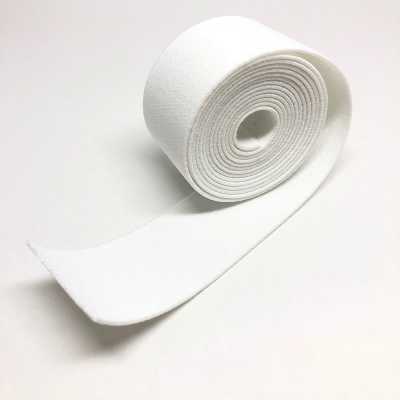
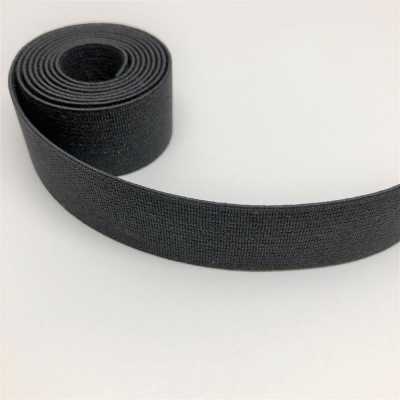
Elastic webbing is a stretchable rubber tape made in a flat, band-like form, used for garment waistbands and cuffs to adjust the fit and level of tightness as an accessory material.
Contents7 sections
Definition and Overview
Elastic webbing is a wide, band-shaped elastic material. In addition to being threaded through fabric, it is also sewn on to create gathers or used as a visible design detail. Compared with round elastic, which has a circular cross section, it applies force over a broader surface, making it easier to achieve a relatively stable fit.
Materials and Structure
Elastic webbing is composed of an elastic core material and yarn that covers and holds it in a band shape. The core material may be rubber or polyurethane-based elastic fiber, and polyester or nylon may be used on the surface. The material combination differs by product.
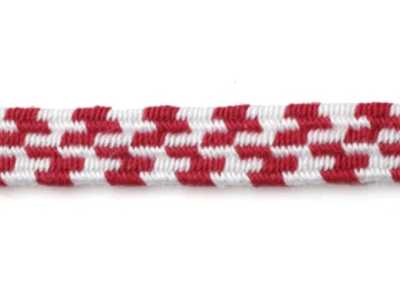
The structure is mainly divided into woven elastic, knitted elastic, and braided elastic. Woven elastic is made by securing the core material with a woven structure, knitted elastic is made with knitted fabric, and braided elastic is made by braiding yarn. Thickness, softness, stretch behavior, and how easily the edges curl vary depending on the structure.
How Width and Stretch Are Expressed
When selecting it, check the width, thickness, elongation rate, and the force required at the necessary extension. Width affects the finished appearance and how it feels against the body; narrow types are used for partial applications, while wider types are used for applications that support a broad area such as the waist.
The elongation rate is a guideline indicating how much the material stretches from its original length when pulled. However, even with the same elongation rate, the wearing feel will differ if the tensile load and recovery vary. In specifications, it is important to state not only the finished dimension but also the elastic length and the amount of stretch during sewing.
- Elastic length: the length to cut in an unextended state.
- Finished dimension: the circumference of the product in its completed state.
- Amount of stretch: the difference created between the elastic and fabric lengths when sewing.
Main Applications
Elastic webbing is used in pant and skirt waistbands, cuffs, hems, underwear, and loungewear. For gathered constructions, it can be sewn to the reverse side of the fabric or threaded through an opening for elastic. Depending on the application, consider skin feel, holding power, and wash durability.
For children's clothing, ease of putting on and taking off is important; for innerwear, comfort against the skin matters; and for sports applications, resistance to shifting during movement is a key selection point. Where it touches the skin directly, it is reassuring to check surface stiffness and edge irritation through prototypes.
Selection and Handling Notes
If elastic webbing is sewn in while stretched more than necessary, it can create excessive tightness or overly strong gathers in the fabric. Decide the elastic length only after combining it with the actual fabric to be used and confirming the circumference when worn, the recovery after stretching, and any waviness after sewing.
Elastic materials may lose recovery or become hardened or degraded over long-term stretching, heat, ultraviolet light, sweat, or detergent exposure. Check the care label and material specifications, and handle it so that high heat is not applied directly during ironing or drying processes.
Differences from Similar Terms
Round elastic has a circular cross section and is suitable for cord-like uses and narrow elastic threading. Elastic webbing is wider, so it is suited to areas where force should be distributed, such as the waist. Corded elastic is treated as a type of wider elastic with the appearance of multiple narrow elastics arranged side by side.
Woven elastic, knitted elastic, and braided elastic are not names that describe elastic webbing by shape; they are mainly names that indicate how it is made. Therefore, when selecting elastic webbing, confirm not only the shape but also which structure it has.
Frequently Asked Questions
How do you decide the length of elastic webbing?
Decide it by combining the product's finished dimension, the fabric's elasticity, the required holding force, and the wearer's feel. It is not always sufficient to simply shorten it by a fixed percentage. Since the required length changes depending on structure and stiffness even with the same width, it is important to make prototypes with the actual fabric and check them after washing as well.
Does elastic webbing become permanently stretched after washing?
It does not necessarily lose its recovery immediately just from washing, but repeated stretching, heat, detergent, drying, and storage conditions may reduce its recovery. It becomes easier to judge by selecting materials and structures suited to the application and performing durability tests in line with the product's washing conditions.