Cored
Cored refers to a trim specification in which a core material is inserted inside tape, loops, cords, and similar items to give them fullness and shape stability.
Contents6 sections
Definition and Overview
Cored refers to a structure in which a core material such as another cord, a bundle of yarns, or monofilament is housed inside the tape or cord that forms the surface. The core material gives the cross section thickness and roundness, and makes the outline easier to show even after sewing.
Cored is not a material name or a single manufacturing method, but a structural term meaning that a core is included. For that reason, even when something is cored, the surface material, core material, firmness, cross-sectional shape, and sewing method vary by product.
Materials and Structure
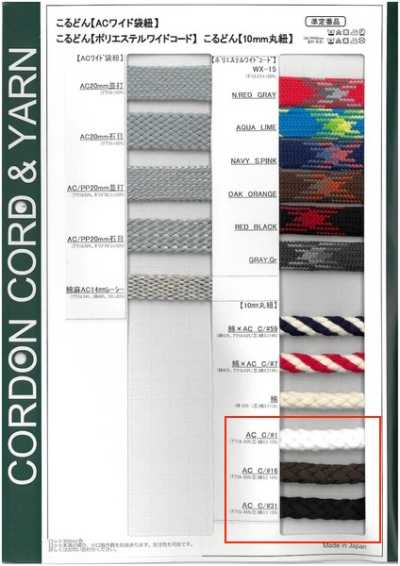
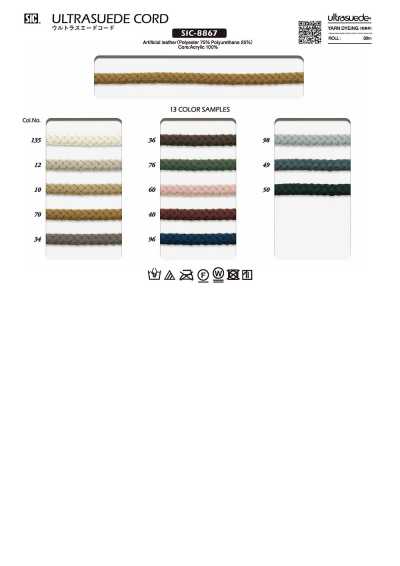
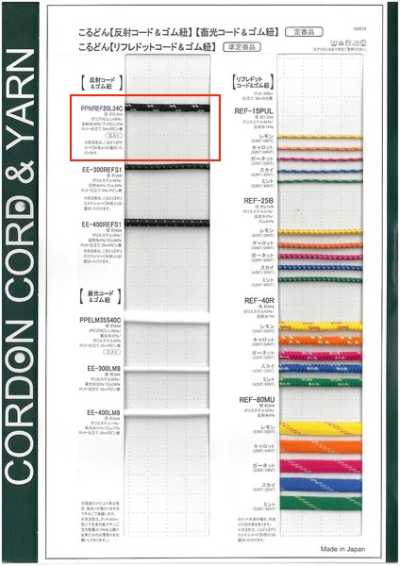
The surface material may be woven tape, knitted tape, braided cord, synthetic leather, and similar materials, while the core material may be a bundle of yarns, round cord, or resin single yarns. There are also cored loops in which the surface material is folded in to cover the core and the ends are secured with stitching.
Weaving, knitting, and braiding describe the construction of the surface part or the core material, and are not synonymous with cored itself. In some cases a braided cord or round cord is used as the core, while in others a flat tape is sewn into a cored finish.
How Dimensions Are Expressed
The dimensions of cored items are expressed by the tape width when laid flat, the finished outside diameter, the thickness of the core, or the inner diameter of the loop. For looped items, the width in the flattened state alone does not tell you the actual thickness that can pass through.
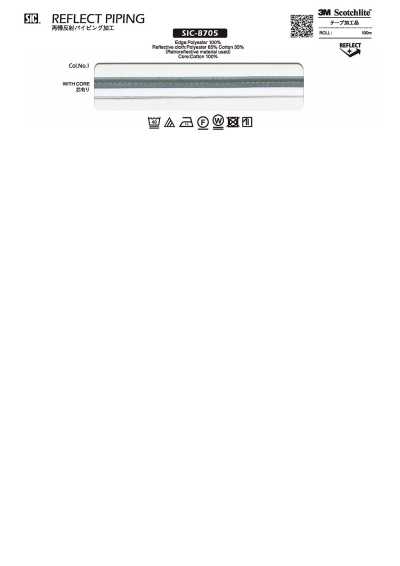
For piping applications, check separately the thickness of the cord portion that shows on the outside and the width of the tape portion that goes into the seam allowance. Clearly stating the measurement position, cross-sectional shape, and allowable dimensional tolerance in the specification helps prevent misunderstandings.
- Tape width: the total width including the flat part
- Cord diameter: the diameter or thickness of the rounded part
- Loop inner diameter: the size of the space for threading a cord or hardware
- Stitch position: the approximate distance from the sewing line to the core
Main Applications
Cored cord and cored piping are inserted into seam lines, pocket openings, collar edges, bag edges, and similar areas to emphasize the outline. Because the core adds a three-dimensional feel, they make it easier to create decoration and separation than with flat seams.
Cored loops are used for button loops, cord pass-throughs, hanging tabs, and similar purposes. In applications subject to pulling force, consider not only the appearance but also the overall strength including the core material, the length sewn in, and reinforcement at the stitching point.
Selection and Handling Notes
If the core is too thick relative to the thickness and texture of the outer fabric, the step at the seam, puckering, or stiffness at corners may become noticeable. Conversely, if it is too thin, the outline may not stand out, so confirm the seam allowance fit and the appearance on the face side with a sample.
Stretch differs depending on the combination of surface material and core material. If a cored item that does not stretch easily is attached to a stretchy outer fabric, rippling or distortion may occur during sewing or wearing. When using it on curved sections, also check whether it bends easily and whether the necessary notching is possible.
During washing or heat treatment, differences in shrinkage between the surface material and core material may cause wrinkles, twisting, or the core to show through. At the ends, the core may slip out or the surface material may fray, so decide on the method of sewing in, folding back, and finishing the ends according to the application.
Frequently Asked Questions
What is the difference between cored piping and regular piping?
Cored piping is a specification in which a core material such as cord is inserted inside the tape covering, creating a rounded fullness in the seam. Compared with flat piping without a core, it differs in cross-sectional thickness, the degree to which the edge is emphasized, and how neatly it sits in the seam allowance.
How do you choose the thickness of a cored loop?
Choose it based on the thickness of the button or cord to be threaded through, the loop inner diameter, the thickness of the outer fabric, and the required strength. In addition to the appearance thickness, confirm with a sample whether the sewn-in part has enough thickness and whether the structure prevents the core from shifting during repeated opening and closing.
Does cored cord shrink when washed?
Whether it shrinks and by how much depends on the materials, processing, and washing conditions of the surface material and core material. With combinations of different materials, rippling due to differences in shrinkage rate may also occur, so it is important to carry out washing tests under the same conditions as the actual product before mass production.