Underbutton
An underbutton is a small button attached behind the position where the outer button is sewn on, reinforcing the button area while reducing concentrated stress on the outer fabric.
Contents6 sections
Definition and Overview
A reinforcement button is a button used to reinforce garments, attached on the underside of plackets, cuffs, and similar areas. It is attached with the same sewing thread as the outer button and helps spread the pulling force applied during fastening and unfastening over a wider area. It is not easily visible from the front and is a trim component related to garment durability and construction stability.
Materials and Structure
Reinforcement buttons are made from materials suited to the garment's application and compatibility with the outer button, such as polyester resin, shell, and nut. Because they are used on the underside, a simpler-looking design than the outer button may be chosen.
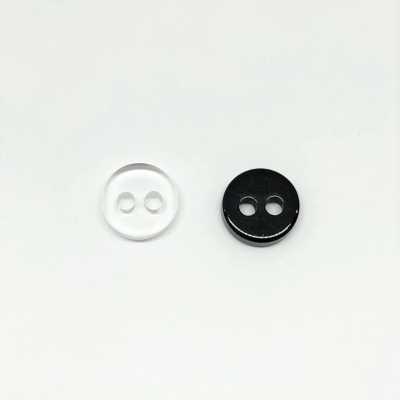
The usual shapes are flat two-hole or four-hole buttons. Because they support the outer button by passing sewing thread through them, buttons with smooth hole edges and moderate thickness are easier to handle. Shank buttons tend to create thickness and pressure points, so they are not usually used as reinforcement buttons.
How Size Is Shown
The size of a button is shown by diameter in mm, and may also be expressed in lignes. A ligne is a unit used for button dimensions, and on specification tables it is checked against the equivalent mm value.
Reinforcement buttons support the stitching position of the outer button and need to remain inconspicuous on the underside. Their dimensions are decided by checking the outer button size, hole placement, textile thickness, seam allowance and front edge specifications, as well as the required supporting area and how the garment sits when worn.
Main Applications and How to Attach
They are used for garments that are likely to be stressed by button fastening and unfastening, such as jackets, coats, shirts, blouses, and pants. For lightweight textiles, low-density woven textiles, and soft textiles, they are considered to prevent tearing of the outer textile and stretching at the button attachment area.
Match the holes of the outer button and the reinforcement button, and attach them by passing the sewing thread through both. In constructions where a thread shank is formed on the outer button, adjust the thread tension so that an appropriate amount of space is left between the outer button and the textile while the reinforcement button on the underside fits closely against the textile.
- Check whether interlining is used and its thickness so that the load is not concentrated only on the stitched area.
- Where the button may touch the skin, check for pressure points caused by the edge or thickness of the reinforcement button.
- Before mass production, confirm ease of fastening and unfastening, and stitching strength with a prototype made from the textile.
Handling and Differences from Similar Terms
Suitability for washing and dry cleaning depends not only on the outer button but also on the material of the reinforcement button. Depending on the effects of heat, detergent, solvent, and moisture, some materials may crack, chip, discolor, or change in gloss. When ironing, check the product care label and the heat resistance of the trim so that direct high heat is not applied.
A reinforcement button is not the button used on the front side to fasten a garment; it is an underside part that reinforces the stitched area. Two-hole buttons and four-hole buttons are names based on the number of holes, while reinforcement button is a name based on function. A buttonhole is the opening through which a button passes, and its role is different from that of a reinforcement button.
Frequently Asked Questions
Does a reinforcement button have to be smaller than the outer button?
It does not always have to be smaller. It is selected based on the fit on the underside, the hole position of the outer button, the required reinforcing area, and the textile thickness. However, if it is too large, it may cause pressure when worn or show through the outer textile, so checking with a prototype is important.
Can a reinforcement button strengthen even a lightweight textile?
A reinforcement button helps distribute the force on the button attachment area, but it does not increase the strength of the textile itself. For lightweight or easily stretching textiles, it should be considered together with suitable interlining or reinforcing fabric, as well as the seam specification, and confirmed by a pull test.
Can a reinforcement button crack or discolor during washing?
The likelihood of cracking or discoloration depends on the material and the washing or cleaning conditions. In particular, the effects of heat, bleach, and dry-cleaning solvents vary by material, so the suitability of both the outer button and the reinforcement button for the handling conditions should be checked in advance.