


Sew-on Snap Button
A sew-on snap button is a sewing fastener with a male and female part that is attached to textile by hand stitching or machine stitching and opens and closes by pressing the two parts together.
Contents6 sections
Definition and Overview
A sew-on snap is a snap-type fastener secured by threading sewing thread through the sewing holes around the edge. Unlike a press fastener, which is crimped with a setting tool, it can be attached without making holes, so it is also used for prototypes and repairs. It is also suitable for applications where it is attached in a hidden position from the front.
Materials and Structure
Typical sew-on snaps are made of metal and consist of a male and female pair. The male side has a protruding part that fits into the other side, and the female side has a receiving part that holds the protrusion. Sewing holes are provided around the outer edge of each part, and they are sewn directly to the textile.
The holding force and opening/closing feel vary depending on the shape of the parts, springiness, surface finish, and other factors. Even with the same outer diameter, the feel changes depending on the specifications, so it is important to attach actual samples to the textile and check them during the planning stage.
How Size Is Expressed
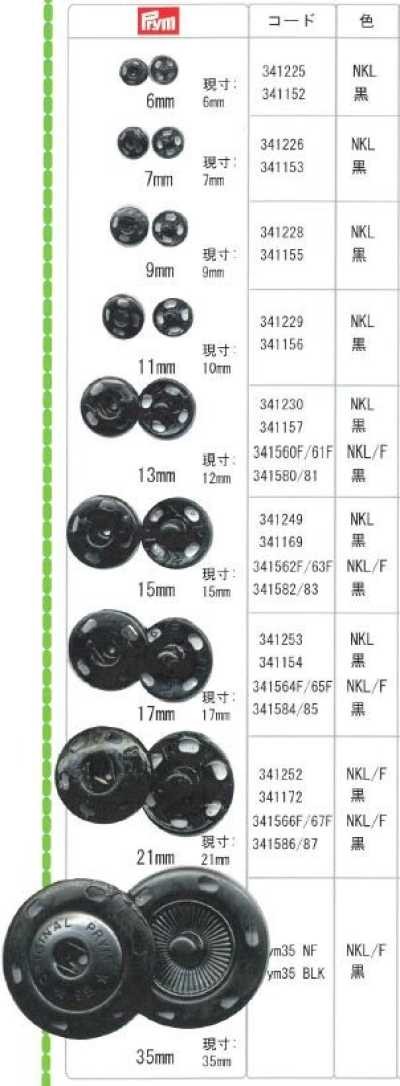
Size is often expressed as the outer diameter of the snap body in millimeters. A larger outer diameter does not necessarily mean stronger holding force, as structure and material also affect it. In orders and specifications, clearly state that it is a pair including the male and female sides, as well as the outer diameter, color, and surface finish.
Choose small, lightweight ones for lightweight textiles, and ones that can handle layered fabrics and stress for thick fabrics such as coats. However, if the textile is too thick, the male and female parts may not engage sufficiently, leading to easier release or difficulty opening and closing.
How to Attach It and Main Applications
Align the attachment position accurately, sew one side first, then check the overlap position and attach the other side. It is important to pass the thread through each hole several times and sew so that the thread does not cross over the moving or engaging parts of the component. If necessary, reinforce the attachment area with a pressing cloth or interlining.
It is used for front plackets, collars, facings, cuffs, pocket openings, and inner garment closures. In addition to being used as a secondary fastener that is not visible on the surface, it is also used together with buttons or zippers to prevent gaping or shifting in the opening.
- For highly elastic textiles, use stretch stabilizers or interlining together to prevent deformation of the attachment area.
- For lightweight textiles, check whether seam puckering or metal impressions appear on the surface.
- Where strong pulling force is applied, consider strength including the thickness of the sewing thread and the number of stitches used to attach it.
How to Choose and Points of Caution
Choose based on textile thickness, weave or knit structure, elasticity, load during putting on and taking off, and whether it touches the skin. Not only the snap's holding force, but also whether the textile at the sewn area will tear is important. For lightweight or loosely woven textiles, the attachment area may be damaged if strong force is applied without reinforcement.
Metal products may rust or discolor due to humidity, sweat, detergent components, or storage conditions. Confirm in advance whether the material and surface finish are compatible with the product's washing conditions. Also, if the product goes through a needle-detection process, confirm whether it is needle detector compatible and how it should be handled in line with the production specifications.
Press fasteners and spring hooks that are fixed by pressing are fasteners that use a dedicated setting tool. By contrast, sew-on snaps are fixed with thread, so they are easier to add later or replace, but the sewing quality greatly affects holding force and durability.
Frequently Asked Questions
Can sew-on snaps be attached with a sewing machine?
Depending on the shape of the sewing holes, the sewing equipment, and the product specifications, machine sewing may be possible. However, if the needle hits the metal part, it can cause needle breakage or damage to the component. Before mass production, confirm whether sewing is possible, the sewing position, and feed stability, and set up a hand-sewing process if necessary.
What should be done if a sew-on snap comes off easily?
Check not only the snap size and holding force, but also textile thickness, misalignment of the attachment position, the number of stitches, and the reinforcement status of the textile. If the male and female parts do not overlap correctly, they will also come off more easily. For areas with heavy load, consider reinforcement with a pressing cloth or interlining.
How should sew-on snaps and press fasteners be used differently?
Sew-on snaps are characterized by the ability to be fixed with thread without making holes, making them easy to use for repairs and specification changes. Press fasteners are crimped with a dedicated tool, so conditions for the attachment process need to be controlled, but depending on the application, stable fixing can be achieved. Choose based on the textile, appearance, required strength, and production method.





