Heavy-duty Snap
A Jumper Hook is a type of press fastener made of multiple metal parts that is riveted onto textile to provide strong holding power and easy opening and closing.
Contents6 sections
Definition and Overview
A jumper hook is a type of press fastener often used on relatively sturdy textiles such as outerwear and workwear. It has a structure that closes by pressing the mating part in and opens by pulling it apart, and its attachment method and holding strength differ from those of sew-on snap buttons.
Press fasteners include several types, such as spring hooks and cap snap buttons. Jumper hooks are generally chosen for applications that require a balance of ease of opening and closing and strength, but their naming and classification may differ depending on the trading partner or manufacturer.
Materials and Structure
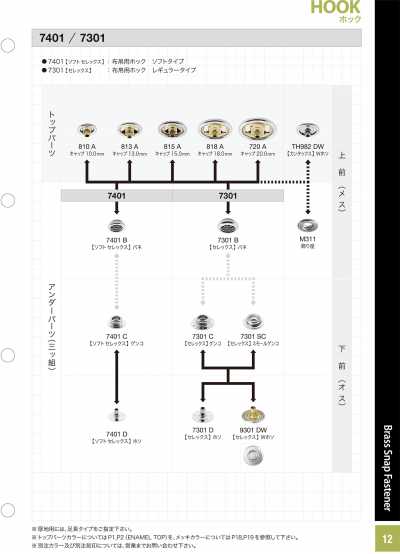
Most are made of metal and combine a head visible on the front side, a receiving part, an insert part, and a leg or washer that holds the textile between them. The front-and-back appearance and the component configuration that accommodates the thickness of the textile vary by product.
Proper fit between the receiving part and the insert part that function as the fastener is important. Even if the appearance or size is similar, combining parts from different series can cause the fastener not to close properly, to come undone easily, or to be improperly set.
- Front-side part: a part visible on the surface, such as the front placket.
- Receiving part: the part that holds the insert side.
- Insert part: the part that fits into the receiving part.
- Leg/washer: a part that sandwiches the textile and secures the components.
How Size Is Indicated and How It Is Attached
Sizes are generally shown based on the outer diameter or head diameter of the front-side part. However, whether the listed value is the nominal size, outer diameter, or corresponding part number depends on the product. When ordering, confirm the standard and the combination of the full set of parts, not only the outside dimensions.
For attachment, mount the compatible setting tool on a hand press or press machine, and set each part in the prescribed order. If the shape or pressure of the tool does not match, it can cause deformation of the parts, scratches, insufficient holding strength, or tearing of the textile, so perform trial setting before mass production.
- Use the body parts and setting tools that conform to the same standard.
- Check the thickness of the attachment area, including the textile thickness, interlining, and overlapping seam allowances.
- Confirm the stiffness when opening and closing, the setting condition, and any scratches on the front and back through trial setting.
Main Applications and Selection Notes
Jumper hooks are used on jumpers, blousons, coats, uniforms, workwear, bags, and more. For front openings and pocket openings subject to pulling loads, select specifications based on the garment application, frequency of opening and closing, and textile strength.
If attached directly to thin or highly stretchable textiles, the setting section may pull out or the textile may tear. Reinforce the attachment area with interlining, reinforcing cloth, or reinforcing tape as needed, and check for stress on the textile caused by a hook that is too stiff.
Metal products may rust or discolor due to sweat, washing, moisture, chemicals, storage conditions, and similar factors. Confirm the type of plating and corrosion resistance, and for products that come into contact with the skin, also consider whether nickel-free specifications are required, depending on the sales region and quality standards.
- For children's clothing or products with safety standards, confirm requirements for tensile strength and part detachment.
- If needle detection is performed, confirm in advance whether needle detector compatible and how it will be operated.
- If product washing, dyeing, water-repellent finishing, or similar processing is performed, evaluate the appearance and opening/closing performance after processing.
Differences from Similar Terms
Press fastener is a general term for snap-type fasteners attached by setting. A jumper hook is one type of press fastener and does not refer to all press fasteners. In specifications, indicating not only "jumper hook" but also the size, color, front-and-back component configuration, and attachment position helps reduce misunderstandings.
A spring hook is a type of press fastener that fastens with a spring structure on the receiving side. A cap snap button is a punched button mainly used on denim products, and its opening and closing mechanism and applications differ. A sew-on snap is attached with thread, so it is distinguished from a jumper hook that is set by pressing.
Frequently Asked Questions
Can jumper hooks be attached to thin textiles?
Attachment itself may be possible, but with thin textiles alone, stress can concentrate on the setting section, causing pull-out or tearing. It is important to reinforce with interlining or reinforcing cloth and perform trial setting at the actual overlapping thickness to check deformation of the textile and the holding condition during opening and closing.
Can setting tools for jumper hooks be shared?
Use setting tools that match the shape, size, and attachment order of the parts. Even hooks with close outer diameters may not be interchangeable if the receiving part or leg shape differs. Be sure to confirm compatibility between the full set of parts and the setting tool before full production.
If it is nickel-free, will discoloration or rust still occur?
Nickel-free refers to a specification that takes into account the amount of nickel used and its release, and it does not prevent all discoloration or corrosion. Appearance may change due to sweat, moisture, detergent, seawater, storage conditions, and similar factors, so corrosion resistance evaluation appropriate to the application is necessary.