D Ring
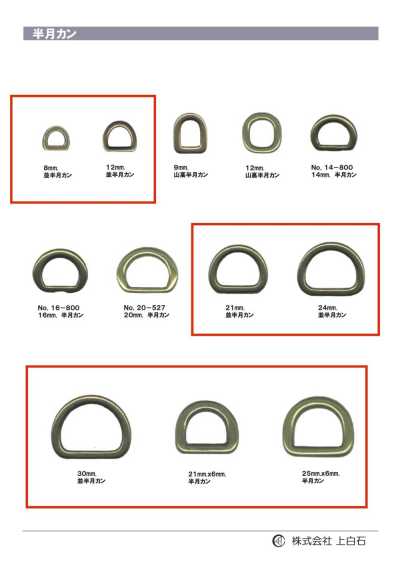
A D ring is a garment accessory hardware piece used for length adjustment, joining, hanging, and similar purposes by threading tape or cord through a D-shaped ring.
Contents6 sections
Definition and Overview
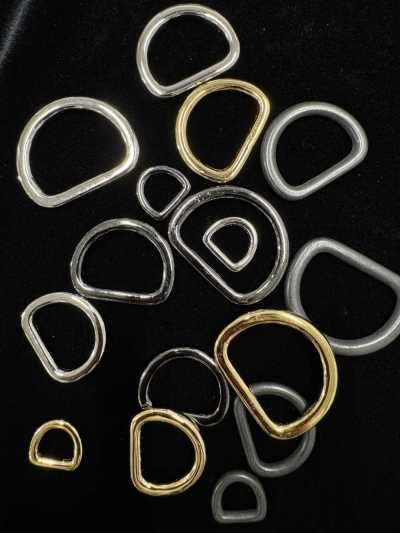
D rings are a type of ring with one straight side and the opposite side curved like the letter D. They are used for connecting parts by sewing tape to the straight side and passing tape or cord through the curved side. Since they do not have an opening and closing mechanism on their own, they are combined with matching tape, snap hooks, buckles, and similar parts.
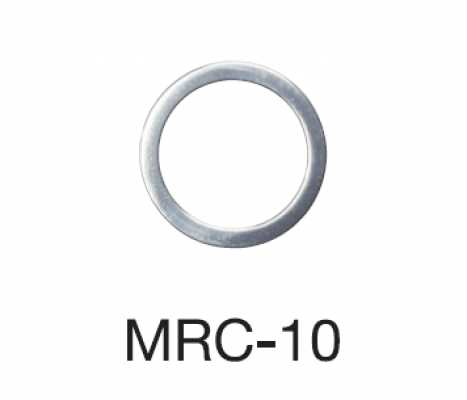
Like circular rings and rectangle rings, they are connecting rings, but D rings have a straight side, which makes it easier to hold tape securely in place. They combine decorative appearance with practicality and are also used as visible trim.
Materials and Structure
For metal types, iron, brass, zinc alloy, and similar materials are used, and some are plated or painted on the surface. Strength, weight, appearance, and corrosion resistance vary not only by material but also by wire thickness, forming method, and surface treatment.
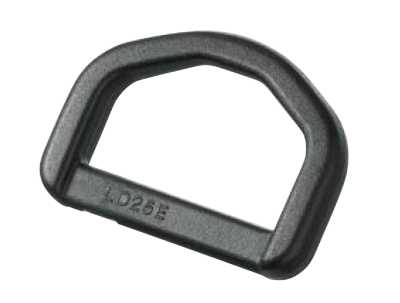
Resin D rings are lightweight and are also used in applications where metal contact should be avoided. However, resistance to low and high temperatures, ultraviolet light, and repeated loads differs by material, so confirmation according to the usage conditions is necessary.
- For one-piece molded items, check whether there are seams and where they are located.
- For metal types, check the plating color tone, wear, and discoloration or corrosion caused by sweat or moisture.
- In apparel, skin feel and the presence or absence of sharp edges or burrs that may damage the textile are also important.
How Sizes Are Expressed
D ring sizes are generally expressed by the inner width through which the tape passes. The basic rule is to match the tape width to the inside dimension. If the tape is thick or is passed through after being folded back, check not only the width but also the inner height and the clearance in the curved section.
Outer dimensions and wire diameter affect appearance, weight, strength, and the fit of the sewn-in section. Even with the same stated inner dimension, ease of threading changes depending on shape and wire diameter, so it is best to confirm by passing the tape through an actual sample.
- Check that the tape width matches the inner width of the D ring.
- For specifications where the tape is folded back, take the thickness from overlap into account.
- When attaching a matching part, also check the opening size of the mating side.
Main Applications
They are used as connecting fittings for bag shoulder straps, belts, suspenders, and adjuster sections. In apparel, they are used for waist belts, sleeve or hem tabs, shoulder straps, and hanging straps, serving as a length adjustment feature and a design accent.
D rings are not parts that fix or adjust tape length by themselves, unlike slide adjusters or loop adjusters. When used in a specification where tape is folded back and threaded through, friction may hold it in place, but the design must account for load and slippage.
Selection and Precautions
When selecting one, organize the tape width and thickness, expected load, frequency of use, and whether washing or wetting will occur. In load-bearing applications such as bag handles and shoulder straps, evaluate not only the D ring itself but also the strength of the tape, sewing method, and reinforcement of the sewn section.
For metal types, weight affects the wearing feel of the product, and rust, discoloration, or plating loss may occur due to humidity, sweat, washing, or friction. In products that undergo needle detector inspection, confirm needle detector compatible status in the material specifications and consider an appropriate specification, including resin types.
- For load-bearing applications, perform strength testing with the finished product or in a state including the sewing specification.
- For washable apparel, check for rust, discoloration, and effects on surrounding textile after the wash test.
- For areas close to the skin, confirm consideration for metal allergies and whether a nickel-free specification is necessary.
Frequently Asked Questions
Where do you measure a D ring size?
Generally, you check the inner width on the straight-side section through which the tape passes. However, even with the same inner width, ease of threading differs depending on wire diameter, inner height, and the shape of the curved section. It is important to confirm, using a prototype or actual sample, whether the tape passes through in its folded-back state.
What is the difference between a D ring, a slide adjuster, and a loop adjuster?
A D ring is mainly a D-shaped ring for connecting tape or cord. Slide adjusters and loop adjusters are parts used to pass tape through and adjust or hold its length. A D ring may also help hold the tape depending on how it is threaded, but its structure and use differ from parts whose main purpose is adjustment.
Can D rings be used on washable apparel?
Yes, but the material, surface treatment, and washing conditions must be checked. For metal types, moisture, detergent, and friction may cause rust, discoloration, or plating loss. Before mass production, perform a washing test with the attachment installed and also check the effect on the textile.
- Browse D Ring products
- Products with material "Aluminum"
- Products with material "Brass"
- Products with material "Zinc"
- Products with material "Iron"
- Products with material "Metal"
- Products with material "Polyacetal"
- Products for style "For Outerwear/blousons/coats"
- Products for style "For Pants"
- Products for style "For Skirts And Dresses"
- Products for style "Outdoor"
- Products for style "For Uniforms/Workwear"
- Products for style "For Bags"
- Browse Buckles And Rings products