All-over Pattern
An all-over pattern is a term for a pattern in which motifs such as flowers, animals, or geometric designs are arranged continuously or across the entire surface of a fabric or product.
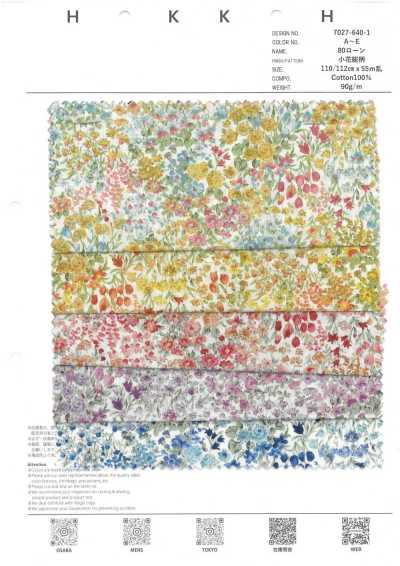
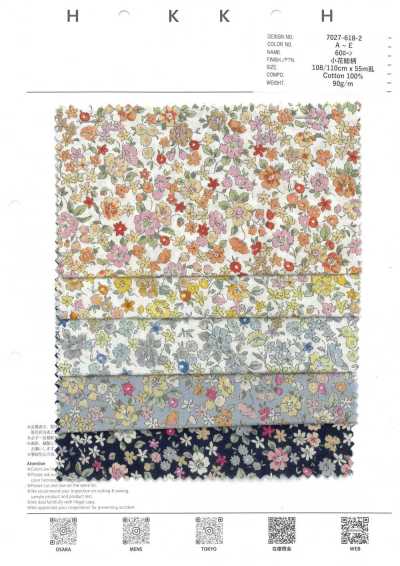
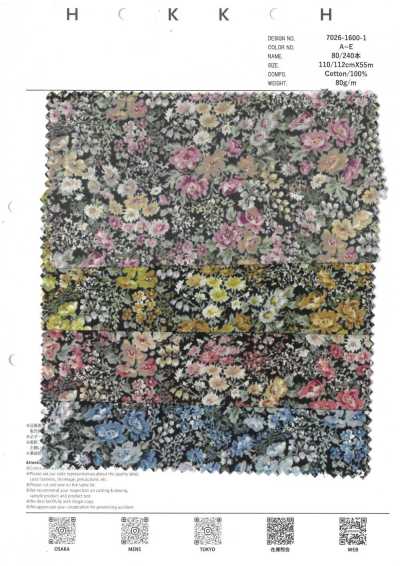
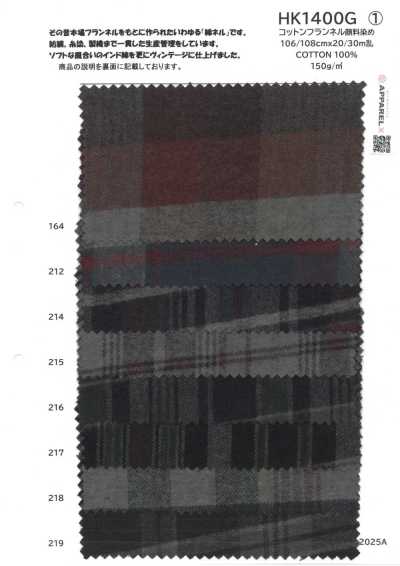
Contents5 sections
Definition and Overview
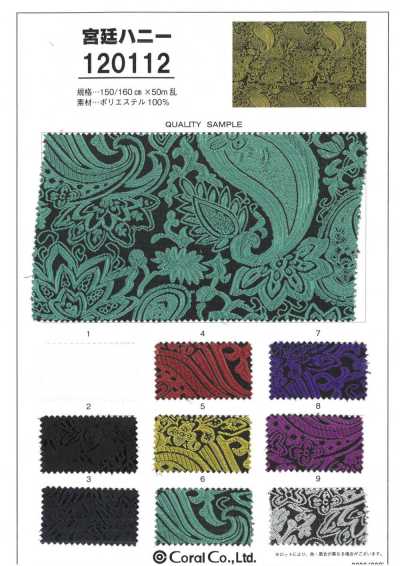
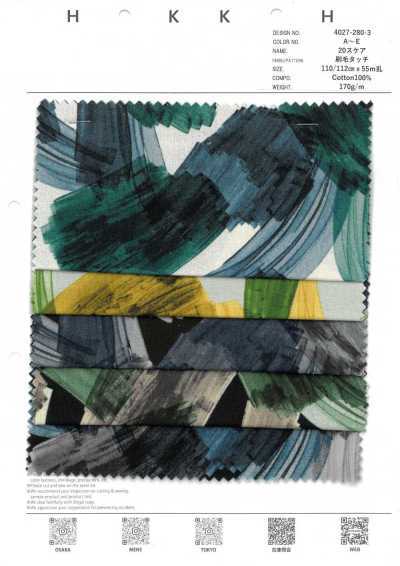
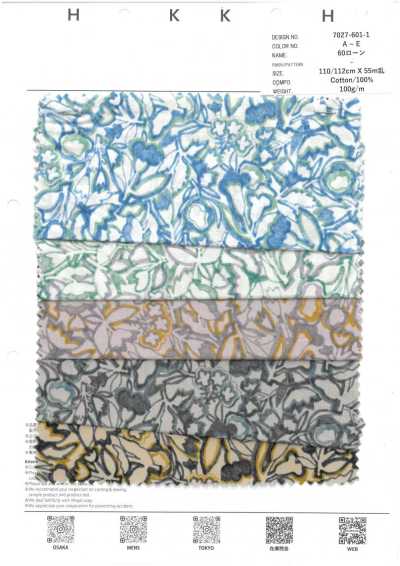
All-over pattern is not a term that refers to a specific type of design, but a term that describes the area over which a pattern is placed. It refers to designs such as floral, paisley, animal, and geometric patterns that extend across the entire surface of a fabric, and includes structures ranging from the repetition of relatively small motifs to arrangements in which large motifs are placed across the entire surface.
When expressed by printing, it may be called an all-over print; when created by weaving, it may be called an all-over Jacquard. Since all-over patterns are not limited by processing method, weave structure, or material, it is necessary during planning to separately confirm the method of pattern expression and the type of fabric.
Pattern Structure and Naming
In all-over patterns, a pattern in a fixed unit is often repeated, and this unit is called the pattern repeat. A structure in which the pattern appears continuous even when the top and bottom or left and right are joined is treated as a continuous pattern. The finished appearance changes greatly depending on the size of the motif, spacing, orientation, and contrast with the base color.
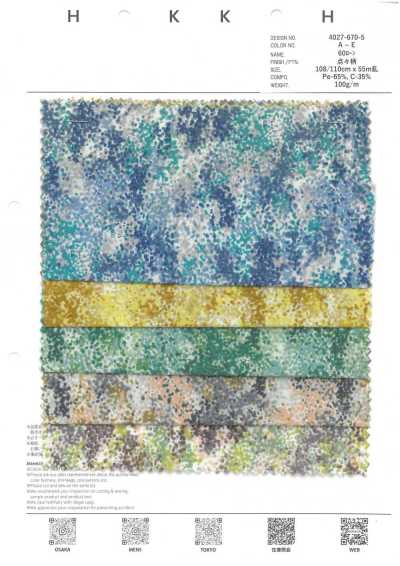
Types of patterns include small repeated patterns such as tiny florals and dots, decorative patterns such as paisley and botanical patterns, and motif patterns featuring animals or people. Large patterns and small patterns are terms that indicate the scale of the pattern and are a separate viewpoint from whether it is an all-over pattern.
- Patterns with a top and bottom may be called one-way patterns.
- Designs placed large only on part of the fabric may be called panel patterns.
- Stripes and checks are also constructed across the entire surface, but they are usually referred to by their own specific pattern names.
Main Applications and Seasonality
All-over patterns are often used for shirts, blouses, dresses, skirts, cut-and-sew tops, and loungewear. Because they tend to draw the eye across the entire fabric, they make it easier to create a decorative look even with relatively simple silhouettes. They are also used as accent applications for accessories, bags, and linings.
Seasonality is not determined by the pattern itself. In general, floral and botanical patterns with a light fabric and bright color palette may be used for spring and summer apparel, while paisley and geometric patterns with deeper tones and a denser feel may be used for fall and winter apparel. However, this is judged according to the fabric thickness and functionality.
Fabric Selection and Cutting Considerations
When selecting all-over pattern fabric, confirm the relationship between the size of the pattern and the dimensions of the item parts. With large patterns, the impression changes depending on which motif appears at the center of the front body, collar, pockets, and so on. For lightweight fabrics, check the sheerness, and for knit fabrics with stretch, also check how the pattern stretches when worn.
During cutting, manage the pattern direction and placement in addition to the grainline. One-way patterns cannot be placed upside down, so cutting efficiency may decrease and required yardage may increase. If it is necessary to match the pattern on the left and right body pieces, collar, placket, pockets, and so on, decide the pattern matching instructions in advance.
- Check the pattern repeat dimensions and fabric width.
- Specify the pattern placement at the center front, center back, and left and right body pieces.
- If pockets or yokes are attached, decide whether pattern matching with the main body is required.
- Before cutting, clearly identify the pattern orientation and the right and wrong sides.
- Estimate the required yardage with more allowance than for solid fabric.
Frequently Asked Questions
What is the difference between an all-over pattern and a floral pattern?
An all-over pattern refers to the state in which a pattern is placed across the entire fabric, while a floral pattern is a type of pattern with flowers as the motif. Therefore, a fabric with flowers placed across the entire surface is an all-over floral pattern, while one with small flowers placed only in part may not be an all-over pattern.
Does all-over pattern fabric require more yardage?
Depending on the pattern direction and whether pattern matching is required, more yardage may be needed than for solid fabric. In particular, one-way patterns, large pattern repeats, and specifications that match patterns symmetrically on the left and right require extra allowance. Confirm the cutting plan based on the pattern and fabric width, as well as the pattern repeat.
What is the difference between an all-over pattern and a panel pattern?
An all-over pattern is a structure in which the pattern is continuous or arranged across the entire fabric. A panel pattern often refers to a structure in which the position of the pattern is fixed near the hem or edge, and during cutting the pattern position must be matched to the pattern pieces.