Tipping
Tipping is a construction method in which the underside of the tip of the wide end and narrow end of a necktie is covered with a separate fabric or the same fabric to reinforce the edge and improve the appearance of the back side.
Contents6 sections
Definition and Parts
In ties, tipping refers to the fabric at the pointed ends on the back side of the wide blade and narrow blade. If the edge of the outer fabric is only folded inward, the fabric edge and interfacing can still be easily seen, so the tipping is added to neaten the inside.
It does not refer to the lining for the tie as a whole, but mainly to the triangular or near-triangular area at both ends. It is distinguished from the wide blade and narrow blade themselves, and from the keeper that holds the narrow blade.
Shape and Securing Method
In general, tipping is cut into a triangular shape that follows the outline of the tip and placed so as to wrap the seam allowance of the outer fabric. After the outer fabric and tipping are sewn together, they are turned right side out and shaped, creating a clean tip.
Many ties are also constructed with the center seam closed by hand stitching, and the area around the tipping is finished so that the stitching does not show on the face side. Left-right imbalance at the tip, seam allowance thickness, and difficulty of turning affect the appearance and bulk.
- Check the angle of the tip and left-right symmetry.
- Make sure the seam allowances of the outer fabric and tipping do not overlap too much.
- Watch for insufficient turning at the point or puckering caused by excessive pulling.
Materials and Finish
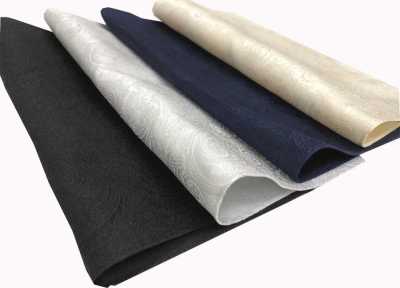
For tipping, lining fabrics such as silk, fabric with a texture similar to the outer fabric, or the same fabric as the outer fabric may be used. The feel, thickness, sheen, and appearance of the pattern affect the drape from the knot to the tip and the impression on the back side.
A specification that uses the same fabric as the outer fabric for the tipping is called self tipping. While it creates a consistent look in color and pattern, if the outer fabric is thick, the tip can easily become bulky, so consideration of the interfacing and seam allowance is necessary.
Relation to Dress and How to Choose
Tipping is an inner part of the tie, and by itself it does not determine whether it is for daytime, evening, full dress, semi-formal, or informal formal wear. When matching an outfit, choose by prioritizing the overall tie color, sheen, pattern, knotting style, and harmony with the shirt and jacket.
In formal settings, ties with a neat overall construction, including the tip, and without excessive color contrast or bold patterns are easier to coordinate. In casual dress, contrasting colors or pattern changes may also be shown as part of the design.
When purchasing or checking specifications, confirm not only the tipping material but also the curvature of the tip, seam puckering, left-right shape, transparency from the outer fabric, and wear or fraying. For storage, do not fold sharply, and if it becomes dirty, follow the care instructions on the product.
Differences from Similar Terms
Tip lining is the Japanese name for tipping. Self tipping specifically refers to a specification that uses the same fabric as the outer fabric for that tip lining, so it is not synonymous with tipping.
Hand rolled finishing is a construction in which the ends of a tie are manually rolled in and finished, and it differs from the method of attaching separate tipping fabric. Seven fold is a construction made by folding the fabric many times, and it is a separate classification from whether tipping is present or its shape.
Frequently Asked Questions
What is self tipping?
Self tipping is a specification that uses the same fabric as the outer fabric for the tip lining of a tie. It creates continuity in the colors and patterns on the front and back, but if the outer fabric is thick or stiff, the tip can become bulky, so the design of the interfacing and seam allowance should also be checked.
Does the presence or absence of tipping determine the formal level of a tie?
The formal level of a tie is not determined by the presence or absence of tipping alone. Formality is judged by the overall material, color, sheen, pattern, construction, and the combination with the occasion and clothing worn. Tipping is mainly a specification related to the finishing of the ends and the design of the back side.